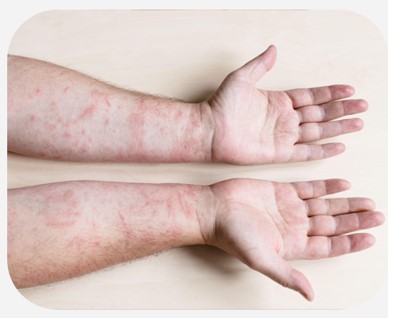
Allergic Contact Dermatitis (ACD) is a type of eczema that happens when your skin reacts to something it has become sensitive to. Unlike irritant dermatitis (which comes from direct skin damage), ACD is an immune reaction—specifically a delayed (Type IV) hypersensitivity response. This means the rash usually shows up 24–72 hours after contact with the trigger.
Common causes include fragrances, preservatives, nickel and other metals, rubber, dyes, certain plants (like poison ivy), and ingredients in skincare or personal care products.
Causes and Pathophysiology
ACD develops after your body becomes “sensitized” to a substance. When you’re exposed again, your immune system (T-cells) triggers inflammation, leading to redness, itching, swelling, and sometimes blistering or scaling. It can happen to anyone, but repeated exposure and a weakened skin barrier increase the risk.